Hybrid dataset
2,152 PlantVillage images and 908 field photographs.
Artificial intelligence for detecting foliar diseases in potato crops
A mobile application developed within Carchi's agricultural context and available to users throughout Ecuador. It combines computer vision, on-device inference and digital tools to support farmers.
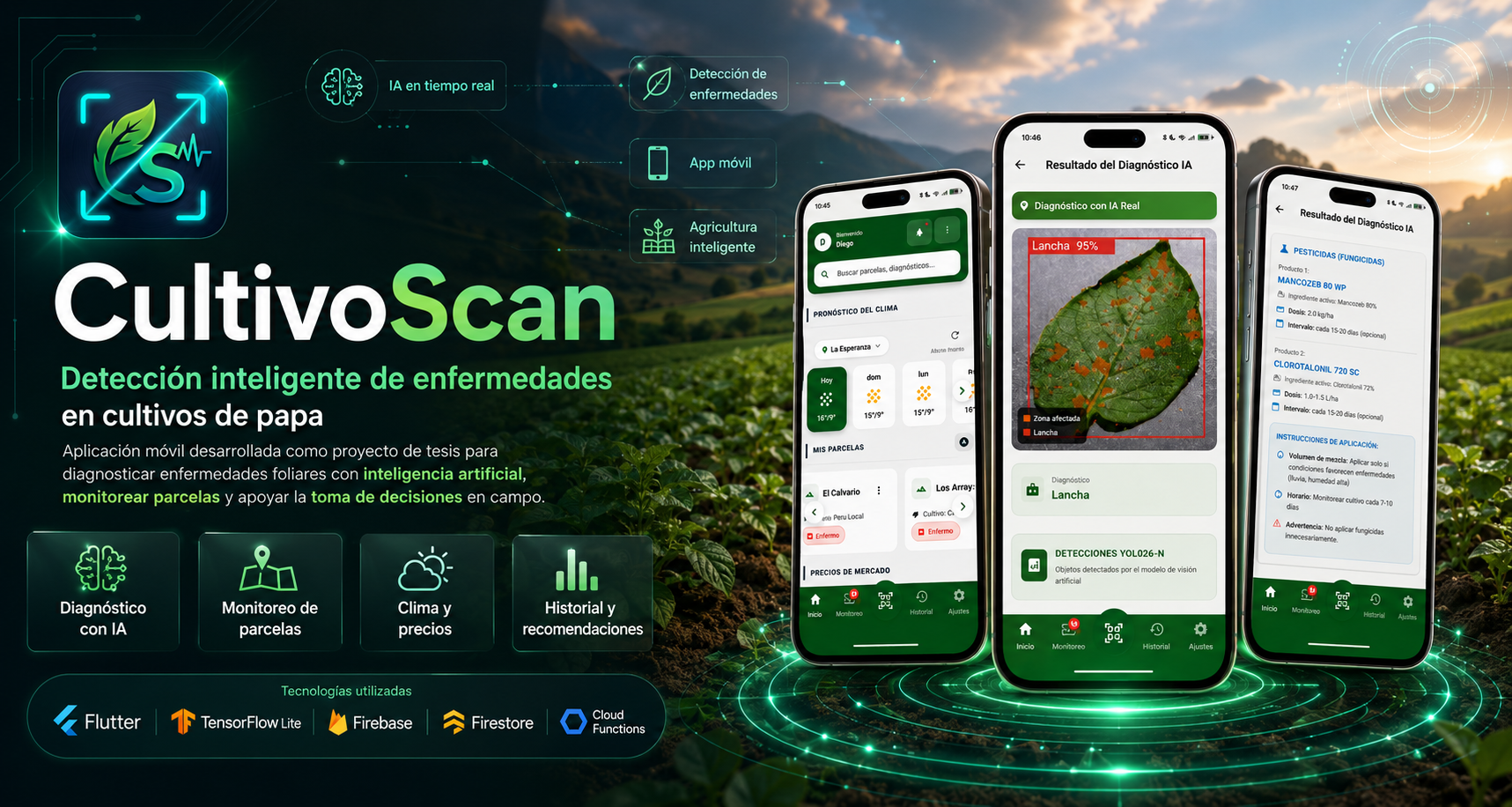
CultivoScan led to a scientific manuscript documenting the construction of a hybrid dataset, the experimental comparison of YOLO and RT-DETR architectures, and deployment of the selected model through on-device inference on Android.
Complete manuscript · Under technical reviewPreparing for submission to a scientific journal
2,152 PlantVillage images and 908 field photographs.
YOLO and RT-DETR variants evaluated for detection performance and efficiency.
Model exported to TensorFlow Lite and validated on an Android device.
CultivoScan was conceived within the agricultural reality of Carchi, Ecuador's leading potato-producing province, and is available to farmers and users throughout the country.
Carchi is one of Ecuador's main potato-producing territories and the agricultural context in which CultivoScan was developed.
Visual identification of foliar diseases can depend on producer experience and access to technical assistance, making timely diagnosis difficult.
CultivoScan analyzes leaf images, runs the model locally and presents the diagnosis, detected region and general recommendations on a mobile device.
PlantVillage and photographs captured in Carchi plots.
Cleaning, bounding-box annotation and training-set augmentation.
Comparison of YOLO and RT-DETR variants.
YOLO-26-N, experiment E12, BoxGain and 1024-pixel resolution.
Export to TensorFlow Lite.
Flutter integration and Google Play publication.
New versions, improvements and future feature expansion.
5.06 ms corresponds to the experimental GPU environment; 559.95 ms to mean TensorFlow Lite inference on the evaluated Android device; and 10.43 s to the mean complete flow from confirming the image to fully displaying the result.
CultivoScan did not end with the graduation project. The application continues to evolve through new versions, diagnosis improvements, dataset expansion, outreach among producers and new agricultural support tools.